
Sleepons versus condition variables (condvars)
Sleepons have one principal advantage over condvars. Suppose that you want to synchronize many objects. With condvars, you'd typically associate one condvar per object. Therefore, if you had M objects, you'd most likely have M condvars. With sleepons, the underlying condvars (on top of which sleepons are implemented) are allocated dynamically as threads wait for a particular object. Therefore, using sleepons with M objects and N threads blocked, you'd have (at most) N condvars (instead of M).
However, condvars are more flexible than sleepons, because:
- Sleepons are built on top of condvars anyway.
- Sleepons have the mutex buried in the library; condvars allow you to specify it explicitly.
The first point might just be viewed as being argumentative. :-)
The second point, however, is significant.
When the mutex is buried in the library, this means that there can be only
one per process—regardless of the number of threads in
that process, or the number of different sets
of data variables.
This can be a very limiting factor, especially when you consider that you must
use the one and only mutex to access any and all data variables
that any thread in the process needs to touch!
A much better design is to use multiple mutexes, one for each data set, and explicitly combine them with condition variables as required. The true power and danger of this approach is that there is absolutely no compile- or runtime-checking to make sure that you:
- have locked the mutex before manipulating a variable
- are using the correct mutex for the particular variable
- are using the correct condvar with the appropriate mutex and variable
The easiest way around these problems is to have a good design and a design review, and to borrow techniques from object-oriented programming (like having the mutex contained in a data structure, having routines to access the data structure, etc.). Of course, how much of one or both you apply depends not only on your personal style, but also on performance requirements.
The key points to remember when using condvars are:
- The mutex is to be used for testing and accessing the variables.
- The condvar is to be used as a rendezvous point.
Here's a picture:
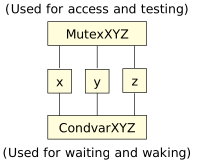
One interesting note.
Since there is no checking, you can do things like associate
one set of variables with mutex ABC,
and another set of
variables with mutex DEF,
while associating both
sets of variables with condvar ABCDEF:
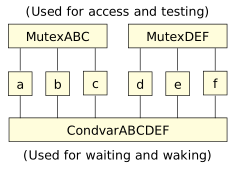
This is actually quite useful.
Since the mutex is always to be used for access and testing,
this
implies that I have to choose the correct mutex whenever I want to look at a
particular variable.
Fair enough—if I'm examining variable C,
I obviously need
to lock mutex MutexABC.
What if I changed variable E
?
Well, before I change it, I had to acquire the mutex MutexDEF.
Then I changed it, and hit condvar CondvarABCDEF
to
tell others about the change.
Shortly thereafter, I would release the mutex.
Now, consider what happens.
Suddenly, I have a lot of threads that had been waiting on CondvarABCDEF
that now wake up (from their pthread_cond_wait()).
The waiting function immediately attempts to reacquire the mutex.
The critical point here is that there are two mutexes to acquire.
This means that on an SMP system, two concurrent streams of threads
can run, each examining what it considers to be independent variables,
using independent mutexes.
Cool, eh?